
Route email by sender
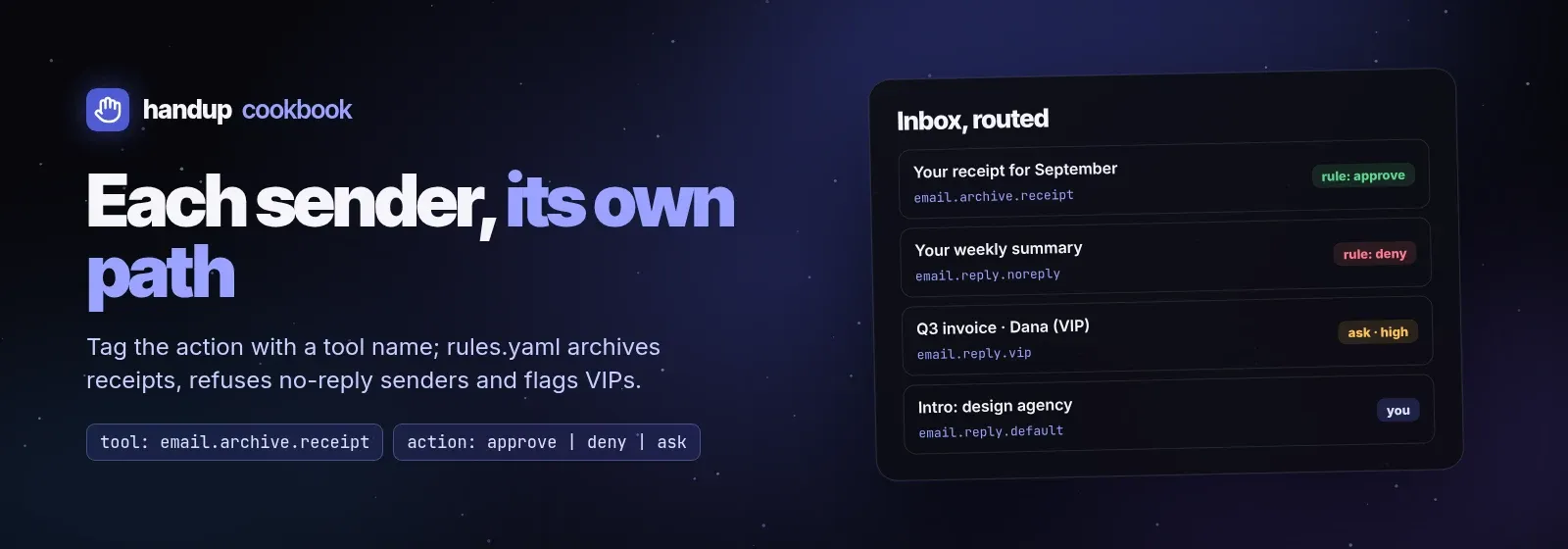
“Handle mail from X one way, mail from Y another” is two decisions: your
script classifies the message, and handup rules decide what each class
needs. The script tags every proposed action with a stable tool name; rules
match that name exactly. Script:
examples/cookbook/email-route.sh,
rules: examples/cookbook/email-rules.yaml.
| Sender / message | tool |
Rule | Result |
|---|---|---|---|
| Subject looks like a receipt | email.archive.receipt |
approve |
Archived with label, no prompt |
no-reply@, noreply@, donotreply@, mailer-daemon@ |
email.reply.noreply |
deny + feedback |
Agent is told why, nothing sent |
Address in HANDUP_VIP |
email.reply.vip |
ask, risk: high |
Prompt with high-risk alerting |
| Everyone else | email.reply.default |
none | Normal prompt |
Paste the rules under rules: in your config (handup config edit;
~/.config/handup/config.yaml on Linux). They apply as soon as you save; an
invalid save keeps the previous rules in force.
rules: - id: mail-receipts-archive match: {agent: mail-assistant, tool: email.archive.receipt} action: approve - id: mail-no-reply match: {agent: mail-assistant, tool: email.reply.noreply} action: deny feedback: Never reply to no-reply senders; archive instead. - id: mail-vip match: {agent: mail-assistant, tool: email.reply.vip} action: ask risk: highMatching on agent as well keeps these rules from touching other agents that
happen to reuse a tool name. First match wins, so put narrow rules above broad
ones. Check a request against your rules without submitting it:
handup rules test request.json.
Classify in the caller
Section titled “Classify in the caller”Classification is ordinary code: sender address, domain, subject, labels your
mail provider already set, or a model’s verdict. The script uses a case and
two greps:
addr=$(jq -r '.from | capture("<(?<a>[^>]+)>").a // .' "$msg" | tr '[:upper:]' '[:lower:]')case "$addr" in no-reply@* | noreply@* | donotreply@* | mailer-daemon@*) tool=email.reply.noreply ;; *) if printf '%s' "$subject" | grep -Eiq 'receipt|invoice paid|payment received'; then tool=email.archive.receipt elif [ -n "$vip" ] && printf ' %s ' "$vip" | grep -Fiq " $addr "; then tool=email.reply.vip else tool=email.reply.default fi ;;esacThe request describes the action, not the email: an archive request has a
title like Archive "Your receipt for September" as Receipts and no editable
input; a reply request carries the draft as editable input.
{ "title": "Archive \"Your receipt for September\" as Receipts", "kind": "review", "tool": "email.archive.receipt", "source": {"agent": "mail-assistant"}, "dedupe_key": "email.archive.receipt:<rcpt-2026-09@billing.example.net>", "timeout": "24h", "previews": [{"type": "email", "email": {"from": "Example Cloud Billing <billing@example.net>", "to": ["ari@example.com"], "subject": "Your receipt for September", "body": "…"}}]}Reading the result
Section titled “Reading the result”A rule decision arrives through the same wait as a human one, with
decided_by: "rule" and the rule_id. The script prints the action to
perform:
$ sh examples/cookbook/email-route.sh examples/cookbook/receipt-email.json{"message_id": "<rcpt-2026-09@billing.example.net>", "tool": "email.archive.receipt", "decided_by": "rule", "action": "archive", "label": "Receipts"}
$ sh examples/cookbook/email-route.sh examples/cookbook/noreply-email.jsondenied: Never reply to no-reply senders; archive instead.      # exit 1
Rule decisions are audited like any other: N auto-handled · View above the
Inbox list opens their read-only view; Mark read leaves them in History
and syncs the read state across devices connected to the same daemon.
handup log --json and GET /v1/requests?decided_by=rule also list them.
Guardrails
Section titled “Guardrails”- Auto-approve only reversible, internal actions (archive, label, snooze).
Sending mail is publication: keep replies on
askordeny. - Keep
toolnames specific.email.replyfor everything would let one approve rule cover every reply. - Classification happens before handup sees the request, so a wrong classification is a wrong rule match. Prefer signals the sender cannot forge easily (your provider’s verified-sender labels) for anything auto-approved.