
Policy auto-decider
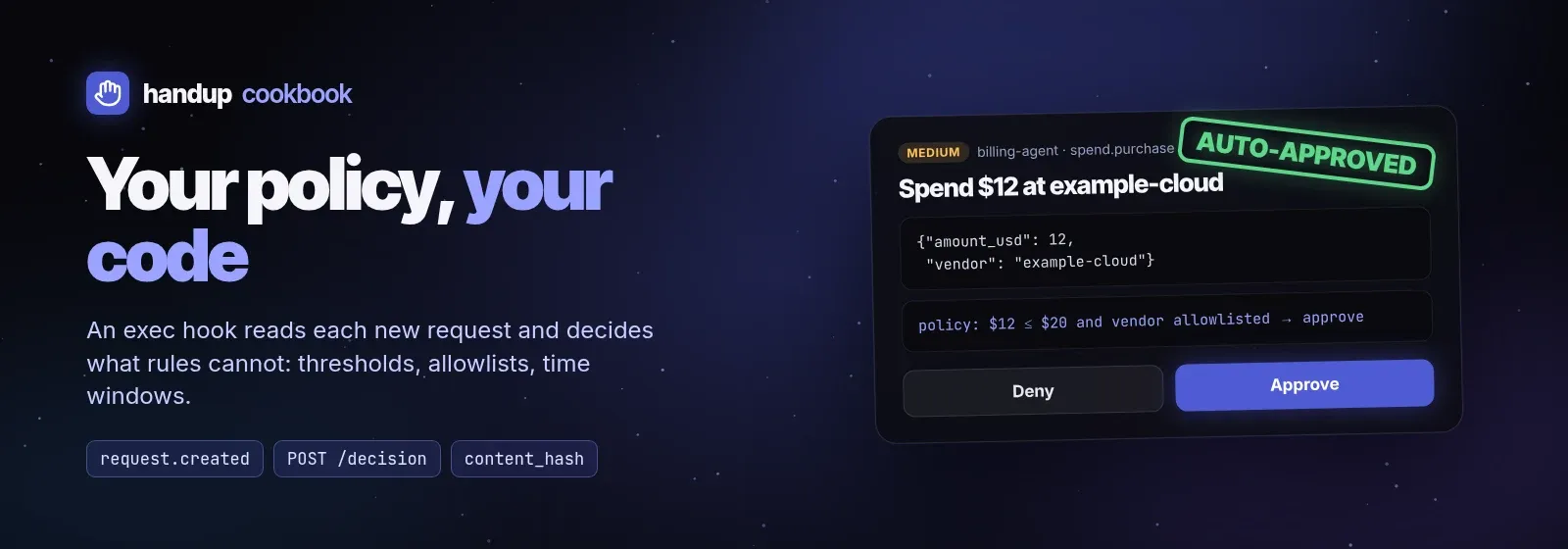
Rules match fixed fields. When the decision depends on the
request’s content (an amount, a vendor allowlist, a time window, which files a
diff touches) write a small policy handler instead. A decide:
hook reads the full request JSON on stdin and prints
a decision JSON object, or nothing to leave it pending for you.
Handler:
examples/cookbook/auto-decider.sh;
requests: examples/cookbook/spend-request.sh.
The example policy covers agent purchases (tool: spend.purchase):
| Condition | Decision |
|---|---|
Vendor allowlisted and amount ≤ AUTO_APPROVE_USD (20) |
approve, with the reason as feedback |
Amount > AUTO_DENY_USD (500) |
deny: “purchases over $500 need a budget request” |
| Anything else | no decision: stays pending for a human |
Hook it up
Section titled “Hook it up”Add the hook to config.yaml; it applies when you save:
hooks: - name: spend-policy decide: /abs/path/examples/cookbook/auto-decider.sh tool: spend.purchaseThe hook inherits the daemon’s environment plus HANDUP_EVENT,
HANDUP_REQUEST_ID, and HANDUP_HOOK. The default timeout is 10 seconds.
No socket, API credentials, or HTTP calls are needed.
The handler
Section titled “The handler”request=$(cat)[ "$(printf '%s' "$request" | jq -r '.tool // empty')" = spend.purchase ] || exit 0
printf '%s' "$request" | jq -c --arg vendors "$vendors" \ --argjson max "$approve_max" --argjson over "$deny_over" ' (.input.amount_usd | tonumber? // null) as $amount | (.input.vendor // "") as $vendor | if $amount == null then empty elif $amount > $over then {option: "deny", feedback: "Policy: purchases over $\($over) need a budget request, not an agent."} elif $amount <= $max and ($vendors | split(" ") | index($vendor)) != null then {option: "approve", feedback: "Policy: $\($amount) at \($vendor) is under the $\($max) auto-approve limit."} else empty end'Why it is shaped this way:
- Full request on stdin. The JSON has the same shape as
GET /v1/requests/{id}, includingtool,input, and previews. - Hash-bound automatically. handup binds the returned decision to the snapshot sent to the policy. Changed content cannot be approved by a stale answer.
- Silence is the default. Anything the policy does not recognize exits 0 without printing a decision, so a human sees it. Never write a fallback approve.
- Races are harmless. A rule, YOLO or a fast human may decide first; handup ignores the hook’s answer if the request is no longer pending.
- Feedback explains the decision. It is shown in History and returned to the agent, so the reason travels with the result.
The request side
Section titled “The request side”$ sh examples/cookbook/spend-request.sh 12 example-cloud "Extra build minutes"{"status":"approved","decided_by":"hook:spend-policy","feedback":"Policy: $12 at example-cloud is under the $20 auto-approve limit.","purchase":{"amount_usd":12,"vendor":"example-cloud"}}
$ sh examples/cookbook/spend-request.sh 900 example-cloud "GPU reservation"denied: Policy: purchases over $500 need a budget request, not an agent. # exit 1
$ sh examples/cookbook/spend-request.sh 60 example-cloud "Bigger runner"# pending: waits for youThe request puts the amount and vendor in input so the policy can read them
and a human can edit them before approving; the script buys decision.fields
when present. Its risk is high above $100, so those purchases alert
loudly when they reach you.
Limits
Section titled “Limits”- Decisions are attributed to
hook:spend-policyin History, Auto-handled, and the audit log. - Decide hooks are best effort and not durable: if the daemon restarts before the hook runs, the request simply stays pending for a human. That is the safe failure.
- Hooks run with the daemon user’s privileges. Keep the handler small, avoid detached child processes, and keep its timeout short.
- For decisions that are pure field matches (agent, tool, risk, command
regex, paths), use rules: they are declarative, tested with
handup rules test, and decide before any hook runs.